A Review of "Women Who Make the World Worse:
And How Their Radical Feminist Assault Is Ruining Our Schools, Family, Military, and Sports" , by Kate O’Beirne (Sentinel, New York: 2006)
Reviewed by Lee Duigon
February 13, 2006
If you’re reading Chalcedon, you probably already know that feminism is a very bad idea that has done real harm to civilization.
Attorney Kate O’Beirne, Washington editor of National Review and a regular on CNN’s The Capital Gang, does a thorough job of trying and convicting feminism for crimes against common sense and sanity. If you have any doubts about that, her book will remove them.
What are feminism’s crimes? O’Beirne devotes a chapter to each count of the indictment: undermining the family; weakening the parent-child bond and putting children at risk; creating dishonest legal theories that ruin people’s lives and hurt the body politic; wrecking our educational system; demolishing college sports; weakening our armed forces; poisoning our political system; and establishing abortion as a kind of feminist sacrament, to the tune of more than 40 million unborn babies killed.
“All these women who make the world worse by waging a destructive war between the sexes are at war with Mother Nature,” she concludes (p. 199).
The Role of the Federal Government
The most revealing insight of the book, not necessarily what the author intended, has to do with the role of the federal government, which empowers and enables feminism by feeding it with uncounted billions of tax dollars. Without your tax dollars, doled out to them by bureaucrats in Washington, feminists would be just another gaggle of loopy malcontents.
What does feminism cost America, just in terms of tax dollars paid out to subsidize it? On every other page of this book, the government steps in to enact new laws, set up new bureaucracies, fund new studies, empanel new commissions — on and on, no end to it, hemorrhaging millions of dollars with every fitful twitch.
Has anyone counted this money? Just from the information given in this book, the total must run into the tens of billions.
And what do we, the people, get out of this? Not much, says O’Beirne. Mostly the money funds programs that function as feminist job banks.
But the money does enable feminists to be powerful, and they’ve wreaked havoc with their power. O’Beirne cites dozens of examples. The whole enterprise, she says, is “an agenda that demands radical social engineering to eliminate any differences between the sexes” (p. xviiii).
As for concrete results:
* Parents today spend 50% less time with their children than they did 40 years ago (p. xx).
* The American Psychological Association holds that fathers are not necessary for the successful upbringing of children (p. 10).
* One third of all American children are born out of wedlock, up from 9% in 1960 (p. 14).
* Our basic civil rights have been abridged. Says UCLA Law Professor Eugene Volokh, “Without much fanfare, the law of ‘workplace harassment’ has turned into a national speech code” (p. 61).
* In our public schools, thousands of boys have been medicated with Ritalin to make them as tractable as girls (p. 74).
* More than 700 “women’s studies” programs have been set up in our universities, where they do little more than turn students into “relentless grievance collectors … too suspicious to function in the workaday world” (p. 86).
* To placate feminists, we have weakened our military — even to the point of putting into harm’s way female soldiers who are too small to use war-fighting equipment safely or efficiently (pp. 130–131).
* Abortion has become the preferred method of birth control, defended by political geniuses like Congresswoman Maxine Waters (D-CA), who once said, “I have to march [in a pro-abortion demonstration] because my mother could not have an abortion” (p. 176).
Every jot and tittle of this — and so much more — has been subsidized by the federal government. Given the harm wrought by feminism, we are tempted to accuse the government of funding the slow destruction of America.
If there ever was an argument for drastically reducing the size and scope of government and hamstringing its power to take and waste our money, this is it.
Down with Mom!
If you still think feminism is about “equal pay for equal work,” read O’Beirne’s book. What it’s really about is having a badly deranged vision of reality.
Feminism displays its true colors in its never-ending quest to denigrate and someday abolish motherhood.
This is not a passing fad, but something that has been with modern feminism from the beginning and still animates it today. We go from feminist icon Betty Friedan in 1963, “It was easier for me to start the women’s movement … than to change my own personal life” (p. 1), to Kate Millet in 1969, “[D]estroy marriage” (p. 2), to Barbara Ehrenreich in 1981 describing the family as “a nest of pathology and a cradle of gruesome violence” (p. 4). Supreme Court Justice Ruth Bader Ginsburg said in 2003, “Motherly love … [is] a myth that men have created” to keep women down (p. 24).
Joan Peters in 1997 declared it’s a bad thing for mothers to be home with their children (p. 26) and was echoed by Professor Gretchen Ritter of the University of Texas in 2004: “Full-time mothering is bad for children” (p. 32). Finally, feminist psychologist Dr. Sandra Scarr has inspired many fellow feminists by describing the mother-child bond as a disease! “New treatments will be developed for children in exclusive maternal attachments (EMA),” she predicted (p. 40). Dr. Scarr is a past president of the American Psychological Association.
Here we leave loopiness behind and enter into the realm of abomination. Godlessness has warped these women’s minds, and government funding has given them the power to influence law and policy. Without the money, they’d just be funny. With the money, the joke is on us.
O’Beirne Off Target
If you want to read hundreds of bizarre feminist quotes and gnash your teeth every time the state lays another boxcar-load of money on them, read O’Beirne’s book. For the time being, let’s jump ahead to her concluding chapter, entitled, “Mother Nature Is a Bitch.”
“Feminists have squared off against Mother Nature, and she’s no feminist,” O’Beirne says (p. 180). Whether they’re railing against “compulsory heterosexuality” (p. 181) or trying to stop scientific research into the differences between the sexes (p. 182), they are always, in the author’s view, kicking against the goads of nature.
But by nature she means just that: blind, insensate nature, governed by laws of natural selection. Mrs. O’Beirne — who has successfully maintained her long-term marriage, and raised two sons, and had the courage and the integrity to yank them out of public school early on and educate them in Catholic schools — disappoints us in the end by opting for a naturalistic explanation of why feminism is wrong.
“The drive for reproductive success dictated the sexes’ behavior,” she writes (p. 184). “If a feminist cave-dweller subscribed to Ms. magazine and bought into being sexually liberated, evolution would have seen to it that her feminist genes would have perished along with her abandoned offspring” (p. 185). Mothering skills, she concludes, are the “result of natural selection” (p. 190), while “Men needed spatial skills to hit moving targets and to make tools” (p. 194), and so on, for a whole chapter.
Well, what’s wrong with making that argument?
First, it simply isn’t true. The Bible tells us that men and women are different because that’s how God created them: “male and female created he them” (Gen. 1:27). God also created the family as our basic social institution, pre-dating tribes, cities, nations, states, etc. All of these more complicated institutions rest on the foundation of the family, and have so rested for the entirety of human history.
By arguing from a standpoint of evolution, O’Beirne puts herself in the same presuppositional ballpark as the feminists. Feminists are naturalists; they believe fervently in evolution. And upon this framework may be erected any just-so story that meets the rhetorical needs of the moment. So we find alleged scientists publishing scientific papers about the evolution of homosexuality as a boon to human survival during some vague, totally conjectural interlude in prehistory.
Evolution is a harlot who’ll go to bed with anyone who pays her. Feminists can certainly find any number of naturalistic, “evolutionary” arguments to justify their program.
We got into this socio-political mess in the first place by turning our backs on God, disregarding His Word, and substituting our own inventions for it. Feminism is one of those inventions. We will not escape from our predicament by coming up with more inventions. Godlessness is the bus that brought us here, and it’s a one-way trip. Mrs. O’Beirne would be well advised to get off.
Only when we stand on God’s Word do we have any firm place to stand at all. Otherwise, moral issues fall into perpetual debate — a debate whose outcome is influenced by outside factors like money, access to the media, political maneuvering, demagoguery, intimidation, and sometimes even violence.
So although O’Beirne has given feminism a black eye, she has by no means won the fight. For that we must put on the full armor of God and wage spiritual warfare.
Lee Duigon is a Christian free-lance writer and contributing editor for the Chalcedon Report. He has been a newspaper editor and reporter and a published novelist.
Thursday, February 16, 2006


Tuesday, February 14, 2006
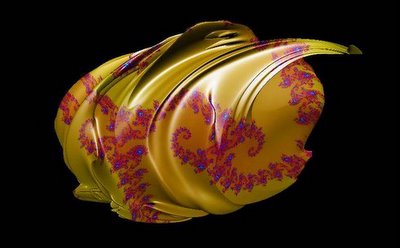
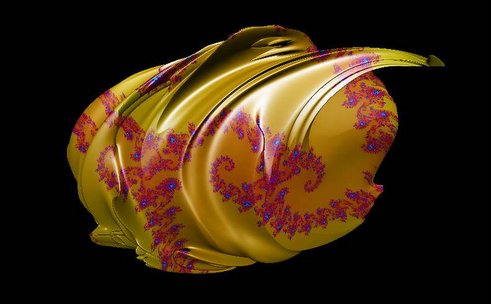
A 3-D fractal image. Produced with ChaosPro software, there are many more beautiful possibilities.
I may post some more images of fractal images.


Saturday, February 11, 2006
A well expressed argument about the cartoons
I personally cannot understand why folk should be "offended" at cartoons of their religion. I incline towards Buddhism myself, but it doesn't concern me if anyone pours scorn upon Buddha, so long as they leave me free to follow the tenets if I wish, and if those tenets do not make life difficult for others. The problem as I see it is that Muslims are, as it were, doctrinally compelled to try to make everyone else a Muslim, and this doesn't suit most people because they find Islam a backward culture. So long as Islam insists on everyone being a Muslim, they will be acting in an uncivilized way and proving it to everyone that they are a backward culture. The same argument applies to Christianity: in medieval times people were prosecuted for not going to church because power-seekers wished to use Christianity to exert power over people; now Muslims wish to arrogate to themselves the right to kill people because their prophet has been "insulted". How does it matter if a prophet is insulted, for goodness sake? What's the big deal?
The Cartoon Jihad: Free Speech in the Balance
We must uncompromisingly defend the right to freedom of speech.
By Christian Beenfeldt and Onkar Ghate
A battle for Western freedom is being fought overseas. The specific object of the battle is merely a handful of cartoons. The outcome of the struggle, however, will reverberate for years.
The conflict began when the leading Danish newspaper Jyllands-Posten printed twelve cartoons of Mohammed to expose and challenge the country's existing climate of fear of criticizing Islam. Confirming the newspaper's nightmares, the response was the deluge of Islamic rage, death threats and violence now sweeping the world.
The issue at stake is the right to speak one's mind.
Recognizing this, many European newspapers reprinted the cartoons. Echoing the story of the defiant slaves, who, when the Romans came for Spartacus, the leader of their rebellion, each proclaimed "I am Spartacus"--this was a clear show of support for the Danish paper and a symbolic affirmation of the right to free speech.
In the United States, however, fear of Muslim anger has suppressed a similar show of support. Indeed, the Bush administration and the mainstream media have generally sided with the raging religionists; while dutifully paying lip service to the First Amendment, their main concern has been for the "hurt feelings" of Muslims. Bush cautioned that we have "a responsibility to be thoughtful about others." Offering similar reasons, major U.S. newspapers like the New York Times refuse to print the cartoons. UN Secretary-General Kofi Annan told the world that "of course freedom of speech is never absolute."
Well, is freedom of speech absolute?
Absolutely.
The right to free speech means the right to express one's ideas without danger of coercion, of physical suppression or interference, by anyone. This freedom includes the right to make movies, write books, draw pictures, voice political opinions--and satirize religion. This right flows from the right to think: the right to observe, to follow the evidence, to reach the conclusions you judge the facts warrant--and then to convey your thoughts to others.
To demand special status for any idea or ideology--to declare Judaism or Christianity or Marxism or Islam off-limits, above public criticism--is to negate these rights. No rational mind can function under the order: Follow the evidence wherever you think it leads, but don't you dare come to a negative conclusion about the philosophy of Marxism or the religion of Islam.
The consequence of making submission to authority and not thought--faith, not reason--the sacred value of a society can be observed throughout the Middle East, where censorship, state propaganda, intellectual stagnation, forced compliance with religious edicts and medieval punishments for religious offences are part of everyday life.
Unlike the Muslims now raging across the world, however, many Americans do cherish free speech--yet may be wondering, when so many other Muslims appear to be offended, is this really the issue on which to make an intransigent stand? The answer to this question is unequivocally yes.
Even if it were true that many Muslims are angered by the specific nature of the cartoons, not by the mere fact that Islam was criticized, their anger is irrelevant. Is a Jew to be silenced because Christians find it offensive that he refuses to accept the divinity of Jesus? Or are the Christians to be silenced, because the Jew finds the Trinity offensive? Is the atheist to be silenced, because Jew, Christian and Muslim alike find his ideas offensive? Maybe all the scientific heirs to Galileo should be silenced, as Galileo himself was by the Church, since those who take the Bible literally are angered by the claim that the earth moves?
If we allow anyone's feelings to reign, we destroy freedom of thought and speech.
In a free society, anyone angered by someone else's ideas has a simple and powerful recourse: don't buy his books, watch his movies, read his newspapers. If one judges his ideas dangerous, argue against them. The purveyor of evil ideas is no threat to those who remain free to counter them with rational ones.
(Note that many European nations have laws limiting free speech, all of which should be repealed; to protest these, however, one does not demand "equal censorship.")
The moment someone decides to answer those he finds offensive with a gun, not an argument--as many Muslims have by demanding that European governments censor the newspapers or by issuing calls for beheadings and other violence against Europeans--he removes himself from civilized society and any rational consideration.
And against this kind of threat to free speech, every free man must stand up. We must vociferously condemn the attempt by religionists to impose censorship in the West. We must extol--without apology or qualifications--the indispensable pillar of a free society: freedom of thought and speech.
The U.S. press should do so by immediately publishing the cartoons, declaring that "I, too, am Spartacus."
Dr. Onkar Ghate, PhD in philosophy, is a senior fellow at the Ayn Rand Institute in Irvine, CA. Christian Beenfeldt, MA in philosophy, lives in Denmark and is a guest writer for the Ayn Rand Institute (www.aynrand.org/).

Copyright © 2006 Ayn Rand® Institute. All rights reserved.
Sunday, February 05, 2006
A tribute to my wife
MY LITTLE FAT SLUT
I love my little fat slut ...when she laughs deliciously and shows that she likes it when I call her “my little fat slut”
when she is feeding the fishes in the pond, squatting down with her flimsy shorts stretched tight, looking carefully, observing closely, making comments
when she is lying on the bed reading, supporting herself on her elbows, legs slightly apart ... looks up and smiles ...
when she is asleep, breathing softly
when she is sweeping the floor
when she is cooking and singing to herself
when she is riding in the tricycle and smiling
when she is sitting beside me in a public tricycle (they are small and there is not enough space for two really) and I feel her body touching mine, and she puts her hand on my thigh
when she runs past me to open the gate for me so I don't have to get off my bicycle.
when she is dressed up in her flashy blouse decorated with big sequins, close-fitting pants, dangly ear-rings and necklace
when she is lying naked on her back, throwing her head back, lifting her cunt with muscular surges while I finger it, and rolling her widely parted legs spasmodically from side to side
when she is lying on her front, lifting her fat little arse and twitching her legs and feet, while I ...etc
when she is reading a book, sitting in a small chair and leaning back a little, holding the book rather far away
when she is kneeling on the bedroom floor with books and papers all around, sorting out the accounts in the many savings bank books she keeps for other people who trust her to look after their money
when she willingly and without demur lies over the table to receive a whipping, and gasps at each stroke
and then afterwards is loving and caressing
when she thinks of important things I have forgotten to take into consideration
when she is vainly trying (at my behest) to get into her college uniform skirt which is four inches too small round the waist
when she comes up behind me suddenly and puts her arms around me, her face touching my cheek and says “Thank you for ...” (a trivial thing I have done; or something I made for the evening meal.)
when she runs to me suddenly and puts her arms around me for no known reason
when she rests her leg over mine while we are sitting outside by the fish pond with drinks, watching the fish and talking desultorily
when neither of us can control the impulse to giggle while playing the game of Evil Headmaster and Naughty Student, thus deflating the drama
when she fills the buckets for flushing the toilet from the pump before going to bed, going out naked into the back porch in the darkness, disregarding the possibility of being seen by passers-by, themselves unseen
when she gets up at 5:30 to cook the rice for our son's school lunch
when she reports that other men have expressed a desire for her favours
when she takes all her clothes off to get into bed with me
when she is dressed in a thong and close-fitting pants of soft cloth that follow her sweet curves
when she walks with that slightly awkward twitch that's not graceful
when she stands beside me and puts her hands on me down there, one in front and one behind
when she rubs her arse against me and titters if I come up close behind her and press my body against hers
when she devotedly visits her old father across the town, most days
when she moves my hand to the place she likes it to be
when she calls me handsome just because I have tucked my shirt into my shorts and put on a belt.
when she treats her friends and family with EFT (tapping), usually successfully, when they have ailments and accidents
when she comes up to me and asks me how I would like the fish cooked
when she spends the greater part of a day at the washing machine getting the clothes very clean
when she walks about the house with no clothes on
when she tends her hundreds of plants
when she is gabbling nineteen to the dozen into the telephone without stopping for ten minutes on end and I don't understand a single word of it
when she takes notice of my wishes about how she should dress
when she listens carefully to me while I am recounting some event or situation and makes herself interested in it, even though others might – probably would – think it was boring or irrelevant
when she acts considerately and helpfully towards her family and friends, while all the time she supports me, finds joy in fulfilling all my desires and wishes and helps me to feel good.
Saturday, February 04, 2006
A misbegotten decision
This blog is becoming very political! But this article does raise a very difficult problem: Afghanistan's economy depends largely on opium production. Attempts to destroy poppy fields in Afghanistan will not be economically productive, and will also be very unpopular with the farmers for whom it is the only possible source of a decent income.
My solution? Leet them grow poppies; de-criminalise drugs, of any kind, worldwide. Let those who will, kill themselves with heroin. What do you think?
South Asia Features
Kabul`s Mission Impossible
By Martin Walker
Feb 3, 2006, 19:00 GMT
WASHINGTON, DC, United States (UPI) -- The vote in the Dutch parliament Friday to send up to 1,400 of their troops to the NATO mission in Afghanistan may help save the battered credibility of the alliance, but it faces something dreadfully close to Mission Impossible.
The United States wants to withdraw some 4,000 troops from the Afghan mission. NATO, or at least its energetic new Dutch secretary-general Jaap de Hoop Scheffer, wants to be seen as militarily useful so it has deployed its first mission outside the traditional European theater of operations.
For the past two years, NATO has deployed some 9,000 troops in and around Kabul. The force includes some 2,000 Germans, about a thousand Turks, the same number of Canadians and just over 500 from Italy, Belgium, Spain and Britain, which is about to send some 3,200 more.
The Canadians are being reinforced to about 2,200, and the overall NATO contingent should soon amount to over 15,000 troops, and moving into some of the dangerous regions that have hitherto be mainly manned by U.S. forces. The British are being deployed to Helmand province, a dangerous zone where the Taliban remains powerful, and which has seen 100 U.S. troops killed over the past 6 months -- an ominous figure, given that the 100th British soldier has just been killed in Iraq.
In order to reinforce this NATO mission, the Dutch went through an agonizing public debate and a political row that brought up all the old European resentments about the Bush administration and the Iraq war, and for a while it threatened to sink the government. The government had to make all sorts of promises, like an insistence that no detained Afghan would be allowed to end up in the U.S. detention center at Guantanamo Bay, Cuba, to win the vote. And they pledged that the Dutch troops would be under strict Rules of Engagement that would let them fight back, but not initiate hostilities, nor fight alongside the U.S. forces on aggressive patrol missions.
The Dutch troops, like their NATO allies, are doubtless all brave, decently armed and trained. They have been assured by their commanders and their politicians that theirs is an important mission, bringing peace to a war-battered land. They will be helping guard the engineers and aid workers who are trying to rebuild, and facing the same extremist Islamist enemy that exploded bombs in Madrid and London.
Oh yes, and they are meant to help fight the war on drugs by supporting the Afghan government`s efforts to eradicate the opium trade and crop, which fuels the heroin that ends addicting and killing young Europeans.
And as part of the Alice-in-Wonderland Rules of Engagement under which NATO operates, the mandate does not allow the troops deliberately to damage civilian property, which means that cannot burn the poppy fields directly, only provide support to the Afghan government employees who will strike the matches.
This is the baffling part of the mission. Outside of drugs, and the money challenged in by aid workers and troops, there is almost no Afghan economy worthy of the name. One in four of the 25 million population is dependent on food aid.
According to the Food and Agriculture Organization of the United Nations, Afghanistan is by far the world`s largest producer of opium. The U.N. Office on Drugs and Crime says the country accounts for more than two-thirds of global opium production, and each of the last three years has seen record crops, despite the 2002 ban on illicit opium poppy cultivation and the trafficking and consumption of opiates. This should come as no surprise, since the poppies that produce opium are estimated to earn approximately eight times more income per acre than wheat, using less water and fewer inputs.
'The livelihoods of about 1.7 million rural people -- around 7 percent of Afghanistan`s population -- are directly dependent on poppy cultivation,' says the FAO.
'And poppy production has spread to more remote, less accessible parts of the country due to increasing political and physical pressure on the main growing areas. For poor rural farmers struggling to survive amid the chaos resulting from more than 20 years of conflict and, more recently, four years of drought, the cultivation of opium poppy has provided relatively secure cash income and the means by which poor farmers and the landless could get access to land. It has also offered the only source of credits and agricultural inputs, with traders often offering advances against future production.'
But the drugs trade is the only bit of the Afghan economy that works. By destroying it, we undermine the chances of President Hamid Karzai`s government to bring order, prosperity or very much else, except more of the $10 billions in Western aid that was promised at this week`s London conference.
Moreover, by destroying the drugs trade, we act as the Taliban`s recruiting sergeants, giving them the opportunity to pose as the defenders of Afghan peasants against the NATO troops and the hirelings of the Karzai government of Kabul. An impoverished Afghan peasant who finally gets some money from his opium crop is not going to welcome the arrival of NATO troops standing guard as the crop is destroyed. He might even join the Taliban in order to protect it.
The United States has been fighting the war on drugs for the past 34 years, with little visible success. Cocaine and heroin remain widely available despite draconian prison sentences. The U.S. Justice Department`s own figures show that 55 percent of federal prison inmates are behind bars for drug offences, and so are 21 percent of adults in state prisons -- a total of some 300,000 people.
In short, the demand for drugs from the West resists strenuous efforts to control it. The Afghan peasants, in the absence of anything else, feed that demand. Understandably, the governments of the West would like to curtail the Afghan supply, in conditions that will make such an effort not only dangerous for the troops, but liable to undermine the very mission of stabilizing the Afghan government they have been sent to fulfill.
This looks like Mission Impossible.
And this is the real danger to NATO. It was the Dutch Army, remember, that under their strict Rules of Engagement as peacekeepers in Bosnia in 1995, were unable to prevent the Serb forces from massacring some 5,000 Bosnians at Srebrenica, which had been declared a `safe zone.` The morale of the Dutch army has barely recovered from this humiliation.
Now they are on another peacekeeping mission in Afghanistan, and a great deal of NATO`s political capital has been expended to get them there. NATO embarked on this operation to show the Americans that they remained serious and important allies. But with this misbegotten decision to join the war on drugs as well as the war on terrorism, they now risk losing more public support at home than any approval they may gain in the Pentagon
Copyright 2006 by United Press International
© Copyright 2003 - 2005 by monstersandcritics.com.
This notice cannot be removed without permission.
Friday, February 03, 2006
Yet more on cartoons of Mohammed
The Prophet and the limits of the freedom of expression
afrol News editorials, 2 February - The publication of cartoons of the Prophet Mohammed in Danish and Norwegian newspapers has caused outrage, boycott calls and violence in the Middle East and North Africa. Several Muslim countries demand an apology from Denmark and Norway. afrol News, published from Norway, questions the motives behind the original publication, but defends the right of media in secular states to publish cartoons of the Prophet. This article was found at the online version of afrol News: www.afrol.com
 |
Facsimile of the Danish daily 'Jyllands-Posten' from September 2005 |
| © afrol News |
Mohammed has become an important personality in the life of all citizens in the world, whether they are Muslims or not. The words and deeds of the deceased Prophet have an impact on local, national and international politics far beyond the Muslim world.
In secular societies with a free press, Mohammed thus has figured in many cartoons over the years, for example as the incarnation of Islam. Despite the strict religious ban on drawing or painting the Prophet or God in Islam, these "guest star" appearances of Mohammed in the Western press so far have not caused protests by Muslims.
When the Danish daily 'Jyllands-Posten' on 30 September last year printed twelve cartoons of the Prophet, things however changed. The editor of the conservative daily had asked Danish cartoonist to draw Mohammed with the intention of "testing" what kind of reactions this would provoke. He wanted to find out whether the rather large number of Muslim immigrants to Denmark were influencing the limits of freedom of expression in the Nordic kingdom.
This "test" caused immediate reactions, with Danish Muslims demonstrating in front of the daily. The editor even received several death threats. 'Jyllands-Posten had achieved what it seemingly wanted - to demonstrate that there exists a conflict between liberal Danish cultural values and the values of the immigrant society. 'Jyllands-Posten' already previously had supported this view, propagated by Denmark's right-wing government.
During the Nordic winter, most Danish Muslims forgot about the provocation, except for a group of activists that went to the Middle East to spread the news about the blasphemy committed in Denmark. As protests against Denmark started to get organised by radical groups in Palestine, the tiny Christian fundamentalist weekly 'Magazinet' of Norway decided to publish the same cartoons "in support of" 'Jyllands-Posten'.
In January, protests in Palestine and Iraq against Denmark and Norway started to turn more violent. Death threats against all Danish and Norwegian citizens in the region were issued by radical groups. A boycott of Nordic products has been implemented in large parts of the Middle East, already costing hundreds of Danes their jobs. Several Muslim countries in the Middle East and North Africa have withdrawn their ambassadors from Copenhagen, awaiting an official Danish government apology. Libya has even closed its embassy in Copenhagen.
In Denmark, the action of 'Jyllands-Posten' found the support of the government and of most Danes. Prime Minister Anders Fogh Rasmussen refused to meet 11 Arab ambassadors to discuss the case and has ruled out giving any apology. At 'Jyllands-Posten', however, pressure was too high and the daily earlier this week decided to apologise for having "provoked" fellow Muslim citizens, but not for publishing the cartoons. The editor resigned from his post.
In Norway, on the other hand, the editor of 'Magazinet' has been heavily criticised by other media and by several politicians, including former Prime Minister Kjell Magne Bondevik of the Christian Party. Most observers hold that the printing of the cartoons was an unnecessary "provocation" by the insignificant weekly, only aiming at causing conflict. Oslo diplomats are trying to tranquilise Muslim leaders but the Norwegian government is not in a position to apologise, given the strong institution of press freedom in the kingdom.
As protests have also been directed towards the European Union (EU), of which Denmark is a member, the case this week caught the attention of the European press. As the cartoons now are "of public interest" due to the conflict and the debate surrounding the limits of the freedom of expression, several leading European media have decided to reprint them. These include 'France Soir' - whose editor was fired for that reason - Germany's 'Die Welt', Italy's 'La Stampa', Spain's 'El Periodico and 'Volkskrant' in the Netherlands. Many more, including afrol News, have carried facsimiles of 'Jyllands-Posten' and the cartoons.
As a Norwegian media that reaches out to many Muslims, afrol News feels obliged to have an opinion on this issue. afrol News is a strict defender of press freedom and is based on a belief that total freedom of expression is a must for development on all levels.
But as with any freedom, the freedom of expression carries responsibilities with it. When you call someone an idiot, you must be able defend your conclusion or face reactions. An expression can be as destructive as a gun. And especially the influential press - which has driven many persons into suicide due to irresponsible reporting - needs to be aware of its responsibilities. For that reason, we operate by ethical guidelines.
Basic press ethics tell us that we shall not seek to create conflict. More in particular, the Norwegian code of press ethics, by which afrol News operates, instructs us to respect other persons' belief and to be thoughtful when making a presentation.
In the view of afrol News, 'Jyllands-Posten' and 'Magazinet' acted in an unethical way when first printing the Mohammed cartoons. They were in their legal right to do so, but statements from the editors of the two publications indicate that the motive was to provoke a religious minority or to demonstrate this minority's tolerance limits. Especially in our times, where Christian and Muslim fundamentalists are trying to provoke a "clash of civilisations" against the will of the moderate majority, such provocations are at best thoughtless.
On the other hand, the death threats against the two editors and against Danish and Norwegian citizens at large by Muslim fundamentalist groups - even if willingly provoked - cannot be accepted. Also the fundamental lack of understanding of press freedom and secular values in Europe as demonstrated by several Arab governments is disappointing.
As the Mohammed cartoons now have turned into a public debate regarding freedom of expression versus religious taboos in all of Europe and in the Muslim world, their reprinting by other European newspapers is obvious. They now have public interest, being the seed of a diplomatic row. The press is even obliged by its own ethics to publish them at this point.
The press "cannot yield to any pressure from anybody who might want to prevent open debates, the free flow of information, free access to sources, and open debate on any matter of importance to society as a whole," our ethical guidelines say. Therefore, some European media have bought the cartoons for republishing while others, including afrol News, print a facsimile of the 'Jyllands-Posten' page in question. The sacking of the editor of 'France Soir' for having published the cartoons at this stage of the debate is incomprehensible.
This debate is of great importance to societies all around the world. Several questions must be discussed: Are some of us abusing the freedom of expression to publish statements that are meant to provoke conflicts? Are some of us abusing this freedom to get cheap publicity? Is a relatively new religious minority in its right when demanding limits to freedom in its new host country? Can Muslims dictate others on their religious taboos? Can non-Muslims dictate Muslims on religious taboos? Do we want to let religious fundamentalists dictate our political agenda?
By Rainer Chr. Hennig
© afrol News
This article was found at the online version of afrol News: www.afrol.com
Thursday, February 02, 2006
More on cartoons of Mohammed
I was very sorry to see that the Danish paper that published cartoons of Mohammed apologised for doing so. Then I was pleased to read that other newpapers in Europe had published the cartoons as well, one affirming the "right to blasphemy".
Muslims must have very little faith in their religion if they feel it will be damaged by a cartoon. If it will, in fact, be damaged by a cartoon then it deserves to be damaged. The whole idea of blasphemy is primitive, anyway. I hope more cartoons ridiculing religious leaders are published, not because I disapprove of those leaders, but because it is important that anyone may poke fun at anyone else without incurring penalties.
Muslims must have very little faith in their religion if they feel it will be damaged by a cartoon. If it will, in fact, be damaged by a cartoon then it deserves to be damaged. The whole idea of blasphemy is primitive, anyway. I hope more cartoons ridiculing religious leaders are published, not because I disapprove of those leaders, but because it is important that anyone may poke fun at anyone else without incurring penalties.
Subscribe to:
Posts (Atom)